
How to Build Better Coping Mechanisms (What You Need to Know)
Stress is an inevitable part of life. What counts is how we deal with it, in other words, our coping mechanisms.
Coping mechanisms are the strategies people use to deal with painful emotions and adjust to stressful life events. Naturally, some of these strategies are more effective than others; in fact, some may even have negative long-term effects on a person’s health and well-being.
Such coping mechanisms are referred to as maladaptive coping mechanisms. Below, we’ll explain in greater detail what maladaptive coping mechanisms can look like—but know that if you recognize a maladaptive coping mechanism in yourself, it’s not a life sentence. You can actively work to build better coping mechanisms by changing maladaptive behaviors into healthier, adaptive ones—and here’s how.
Contact The Meadowglade to learn more about mental health treatment in California.
What Is A Coping Mechanism?
Coping mechanisms are behaviors that help us cope with stress.
At their best, they increase our resilience and help us remain energized and motivated in the face of anxiety and overwhelm. At their worst, they can lead to lifelong bad habits that fuel anxiety and sustain the cycle of stress.
Most people have experienced stressful situations from time to time when they felt unable to cope. Whether those situations involved something as serious as a loved one dying or something as simple as breaking up with a partner, they can trigger us to use a coping mechanism to get over the feelings and emotions that we are experiencing.
Some coping mechanisms are positive and adaptive. They are beneficial, useful and constructive, producing a positive outcome.
However, other coping mechanisms are negative, with damaging, unhealthy and harmful mechanisms which produce a negative outcome.
Although a positive coping mechanism is a good way of overcoming a problem, many people choose negative coping mechanisms instead. This is because, while they don’t offer long-term solutions to problems, negative coping mechanisms do produce an immediate effect, one that reduces your stress in the short term.
Sadly, using a negative or maladaptive coping mechanism only masks the stress and difficult emotions for a short period of time. They actually cause the dysfunction to increase over time by maintaining and strengthening it.
What Are Maladaptive Coping Mechanisms?
Maladaptive coping mechanisms are coping strategies that work for a time but are characterized by unintended negative consequences that may render them counterproductive.
These consequences can be long-term. Many mental illnesses are thought to develop partly as a result of maladaptive coping mechanisms—for example, social phobia is characterized by an avoidance of social situations that induce anxiety.
Another example of a maladaptive coping mechanism becoming a mental illness is substance abuse. Using a substance like alcohol or drugs begins as a way to help the person cope with negative feelings and then develops into a physical dependence on the substance. Hence, an important component of the treatment for substance abuse and other mental health issues involves replacing maladaptive coping mechanisms with better ones.
What Are Some Examples of Maladaptive Coping Mechanisms?
The following are examples of maladaptive coping mechanisms:
Hostility
A person may engage in counterattacks by defying, abusing or blaming others to cope with their negative emotions. For example, someone who is being broken up with may hurl attacks at the person breaking up with them to feel better.
Status-Seeking
Someone may overcompensate for negative emotions by way of impressing, high-achieving, attention-seeking and status-seeking behaviors. If someone has learned from their parents or caregivers that they were not good enough as they were, they may cope by attempting to earn their love with achievements and status.
Manipulation
When a person is incapable of meeting their own needs, they may resort to dishonesty, seduction or conning to convince someone else to help them. An example of this is if a person does not get their way in an argument and covertly manipulates the other person into admitting they are right.
Passive-Aggressiveness
Someone who is passive-aggressive may appear overly-compliant or passive, yet rebel in secret via procrastination, backstabbing, pouting, lateness or other petty means. A classic example of passive-aggressive behavior comes from one roommate leaving a sarcastic note about something their housemate has done, rather than confronting the problem face-to-face.
Dependence
Relying on others can be healthy to a degree, but someone who uses dependence as a coping mechanism may be overly-submissive, hiding their true desires and giving into others’ demands easily. For example, a partner who fears that their significant other will leave them may allow their partner to choose everything from what they eat for dinner to how they wear their hair.
Obsessions
An excessive need to maintain control and strict order through planning and routine is commonly a maladaptive coping mechanism. Many people with anxiety or obsessive-compulsive disorder exhibit this behavior, holding others to rigid standards in order to cope with their uncertainty about the future.
Social Withdrawal
Sometimes, we need to be alone for a while to sort out our feelings—but when this coping mechanism is taken to the extreme, someone may completely avoid others and shut friends and family out so they can avoid getting hurt or hurting others. Social withdrawal is frequently seen in social phobia and depression.
Stimulation-Seeking
These compulsive behaviors are often unhealthy for us and can include excessive risk-taking, gambling, sex, shopping or too much exercise. You can easily see how any of these behaviors, when taken to the extreme, can get a person into trouble. For example, a shopaholic who uses their credit card to cope may find themselves in crippling debt as a consequence.
Addictive Behaviors
Addictive behaviors can be summarized as “too much of a good thing.” When self-soothing becomes compulsive, it becomes maladaptive. Addictions to alcohol, drugs, sex, food, shopping, or gambling, among other things, are a coping mechanism that allows others to avoid directly confronting their problems via self-distraction.
Psychological Escape
A person who wants to avoid their problems may turn inward, using fantasy, denial or dissociation to escape from their everyday life. This can be positive to a degree—for example, reading a book to escape to another world. However, when taken to the extreme, it can lead to neglecting one’s real-world responsibilities or refusing to take responsibility for one’s actions.
Avoidance
Anxious avoidance is an extremely common strategy employed to cope with situations that make you feel afraid. It makes sense on the surface to try to stay away from anything that makes you anxious or worried. However, over time, that fear is strengthened and maintained if it isn’t confronted. While avoidance brings immediate relief, learning to confront your worries is the best way forward in the long run.
How to Change an Unhealthy (Maladaptive) Coping Mechanism
Long-term change is never easy. The longer we have relied on our unhealthy coping mechanisms, the more difficult they are to replace with healthier behaviors.
If you have ever made a New Year’s resolution before, you probably know what it’s like to try and fail at establishing a healthy habit. Even though we know they are good for us, we are always tempted to turn back to what we know.
Changing an unhealthy coping mechanism can be challenging, but it gets a little easier when we understand the psychology of building new habits and tolerating distress.
Here are a few actionable tips for replacing unhealthy coping mechanisms with better habits:
Take Opposite Action
Dialectical behavior therapy (DBT) teaches distress tolerance skills to help patients build greater resilience to overpowering emotions.
In DBT, patients learn how to tolerate distress in a number of ways, but one of the most important strategies is taking opposite action. According to DBT, we can improve our distress by acting oppositely from the emotion or impulse we are feeling.
For example, if feeling stressed would normally trigger us to order unhealthy takeout, we might cook a healthy meal for ourselves instead. We might not always “feel like” taking opposite action based on our emotions in the present moment, but by replacing negative behaviors with their antonyms, we can substitute positivity and resilience for stress.
Replace Negative Thoughts
Cognitive-behavior therapy (CBT) thinks of our behaviors as a product of our thoughts, and our feelings as a product of our behaviors.
In other words, by changing our thoughts, we can substitute more positive behaviors for negative coping mechanisms. Building confidence helps us build resilience to stress, so we can become more resilient simply by engaging in positive self-talk.
For many of us, negative thinking patterns become automatic, just as our habits do. By replacing automatic negative thoughts with their positive opposites (as we would with our behaviors in DBT), we can retrain our brains so that in time, automatic positive thoughts replace automatic negative ones, and positive self-talk replaces negative self-talk.
What Are Adaptive Coping Mechanisms?
In order to understand how to change maladaptive coping mechanisms into better ones, we have to first comprehend what adaptive coping mechanisms look like in the real world. After all, for someone who has always used maladaptive coping mechanisms to deal with their emotions, it can be difficult to even imagine what a more constructive coping strategy might be.
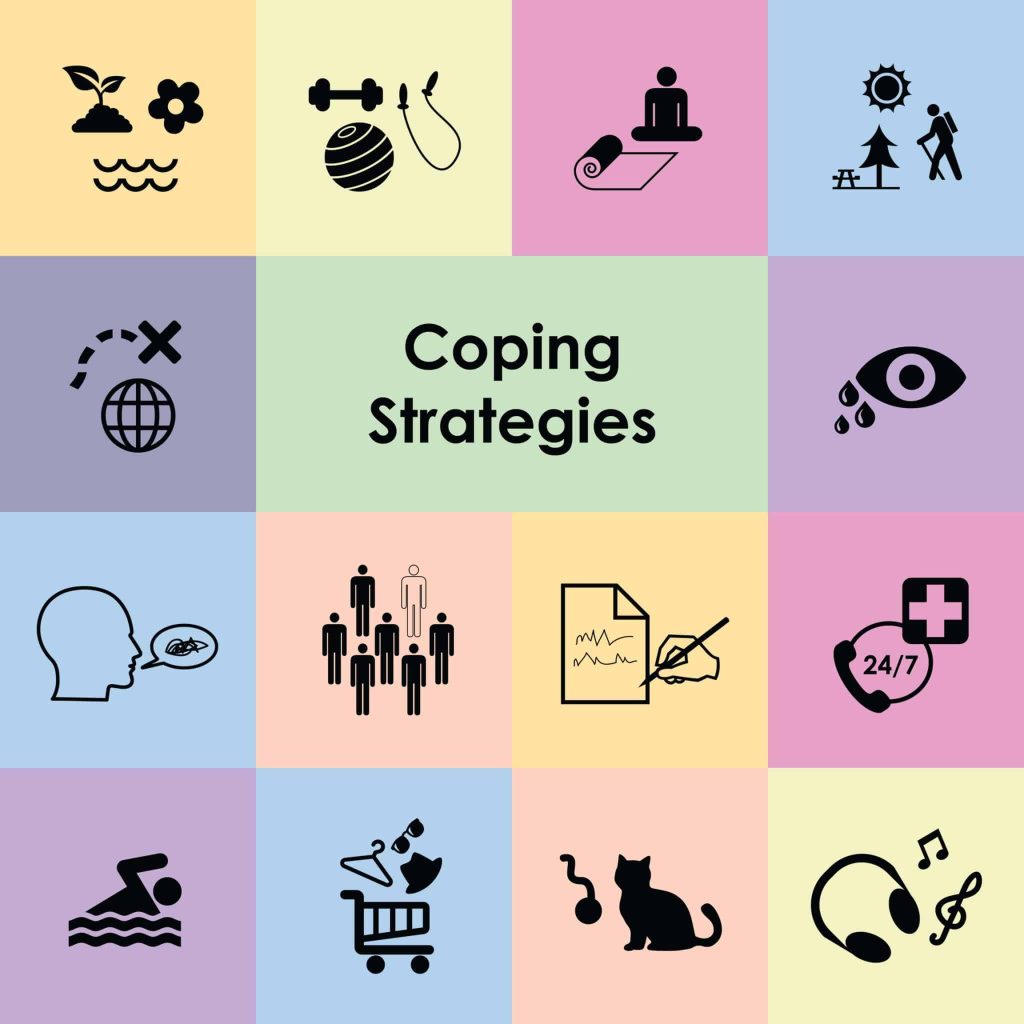
The first step toward changing maladaptive behaviors is identifying the behaviors we wish to develop instead. Hence, below we provide a list of adaptive coping mechanisms you may want to try in place of harmful maladaptive ones.
Remember, it takes time to build a habit, and the first adaptive coping strategy you try may not work for you. Thus, it’s helpful to identify a number of strategies you can see yourself trying, in case you don’t find the right fit immediately. Afterward, we’ll talk about how to put these positive coping mechanisms into place in your life to help you shift from relying on maladaptive coping strategies to utilizing more constructive ones.
What Are Examples of Positive (Adaptive) Coping Mechanisms?
Here are some common adaptive coping mechanisms that you may want to try on for size:
Adaptation
Humans are an extremely adaptive species, meaning we can learn to adjust to any change that comes our way. Someone who experiences a big life change, such as a move to a new state or a staggering disappointment, and decides to use it as a positive opportunity is using adaptation as a constructive coping mechanism.
Compartmentalization
Occasionally, we may have thoughts or beliefs that conflict with one another. We may learn to live by different values in the different groups to which we belong. This can be a positive coping mechanism because it can lead us to get outside our comfort zone. By creating a new “compartment,” we can rationalize doing something we may not normally do, even if it is good for us.
Crying
Do you ever find that you feel better after a long cry? Some of us have been taught to view tears as weakness, but in fact, they can be a form of catharsis, allowing us to release pent-up emotions. By crying, we can also seek comfort from others, as our tears stimulate the natural empathy in others. In other words, crying can be a perfectly healthy coping mechanism!
Sublimation
Sublimation can be defined as channeling our energy into positive activities. In sublimation, we may have an urge to do something harmful and self-destructive, but instead, take that urge and put it toward another activity. The result can be a constructive and valuable piece of work—like a painting or novel borne out of negative emotions.
Undoing
Someone who does something wrong may compensate by performing an action that partially undoes the wrongdoing. Our action has conflicted with our values and we must do something to alleviate our shame. This can be a form of apology through action, even if we don’t use the words “I’m sorry.” An example is buying your partner flowers after a fight.
Exercise
Exercise is a powerful coping mechanism for stress and anxiety.
Healthy eating
Taking care of the body allows us to take better care of the mind. While many of us want to reach for “a little treat” like chocolate or chips when we are stressed, a more useful approach is to pay attention to the nutrition we are intaking daily. Although all food is totally fine in moderation, what we put in our bodies can have a direct effect on our mood and stress.
Social support
Spending time with family and friends may be the last thing on our minds when we have a packed schedule—but it’s even more important to make time for socializing when we are stressed.
Relaxation techniques
Relaxation techniques are like a mini-vacation for your mind. In fact, meditation has been shown to have a longer-lasting effect on stress than a “real” vacation. Yoga, meditation, or even taking a bath can give you a few moments of mental space from stress, allowing you to go back to the day’s activities feeling relaxed and refreshed.
Problem-solving techniques
Perhaps the best way to reduce, or even eliminate, stress is to solve the problem that’s stressing you out in the first place. The problem-solving process can be broken down into four simple steps: examining the problem, defining the problem, brainstorming solutions, and taking action.
The Importance Of Developing a Positive Coping Mechanism
Although most of us want to find positive ways to cope with stressful and difficult situations rather than relying on negative behaviors, unfortunately as humans we seem to have an instinctive tendency to turn towards maladaptive coping strategies in times of crisis. It’s therefore important to be aware of which coping methods are negative and which are positive, and take proactive action to stop yourself from using negative strategies and focus on positive methods instead.
Whenever you feel stressed or afraid, you should confront your fears and try to stop yourself from running away. By remaining in the situation, you will learn eventually that anxiety abates over time.
You should also maintain a positive lifestyle, exercising and eating in a moderate and healthy way. By taking up a productive pastime like knitting, woodwork or baking, you can also learn how to distract yourself from stress in a positive way rather than engaging in negative distraction techniques like compulsive shopping or drinking to excess.
Remember, our maladaptive coping mechanisms work—that’s the problem. A trauma-informed, DBT-anchored reframe that treats coping as protective adaptation, not character flaw or failure of willpower.
Although a negative coping mechanism may bring you instant relief, over a long time it will only cause more damage. Therefore, mental health therapy can help point you towards more adaptive mechanisms to live a happier life with positive outcomes whenever you’re faced with a stressful situation.
Start Mental Health Treatment in California Today
Our trained therapists here at The Meadowglade can help you replace unhealthy habits with more constructive ones while monitoring you closely to keep you safe from self-destructive urges.
Contact us today to begin mental health treatment in California.